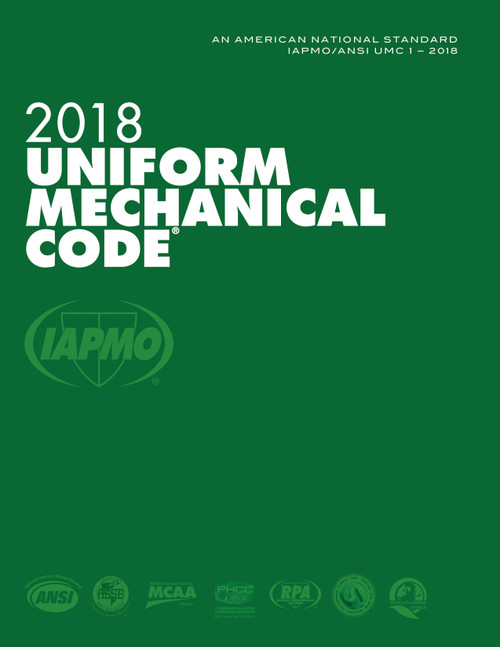


2027 UNIFORM MECHANICAL CODE
The 2027 edition of the Uniform Mechanical Code (UMC®) represents the most current approaches in the mechanical field. It is the ninth edition developed under the ANSI Consensus process is designated as an American National Standards by the American National Standards Institute (ANSI). Contributions to the content of this code were made by every segment of the built industry, including such diverse interests as consumers, enforcing authorities, installers/maintainers, labor, manufactures, research/standards/testing laboratories, special experts and users.
The UMC provides complete requirements for the installation and maintenance of heating, ventilating, cooling and refrigeration systems, while at the same time allowing latitude for innovations and new technologies.
Key changes to the 2027 UMC include:
- New exhaust ventilation requirements for auto repair garages, indoor DC fast‑charging EV spaces, and LP‑Gas facilities
- Updated certification pathways for qualified personnel performing ventilation system testing, adjusting, and balancing (TAB) and duct leakage testing
- New provisions for laboratory exhaust systems
- New provisions for exhaust systems conveying radioactive materials
- New prescriptive requirements for grease duct leakage testing
- Updated provisions for refrigeration systems including releasable refrigerant charge limits (EDVC framework), machinery rooms, and refrigerant piping/shaft requirements
- New provisions for masonry heaters, including dedicated compliance pathways for listed and site‑built systems
- New provisions for district energy systems, expanding beyond Ambient Temperature Loop (ATL) systems
- New Appendix H provides minimum requirements to address Legionella growth in mechanical systems
-
2027 UNIFORM MECHANICAL CODE
The 2027 edition of the Uniform Mechanical Code (UMC®) represents the most current approaches in the mechanical field. It is the ninth edition developed under the ANSI Consensus process is designated as an American National Standards by the American National Standards Institute (ANSI). Contributions to the content of this code were made by every segment of the built industry, including such diverse interests as consumers, enforcing authorities, installers/maintainers, labor, manufactures, research/standards/testing laboratories, special experts and users.
The UMC provides complete requirements for the installation and maintenance of heating, ventilating, cooling and refrigeration systems, while at the same time allowing latitude for innovations and new technologies.
Key changes to the 2027 UMC include:
- New exhaust ventilation requirements for auto repair garages, indoor DC fast‑charging EV spaces, and LP‑Gas facilities
- Updated certification pathways for qualified personnel performing ventilation system testing, adjusting, and balancing (TAB) and duct leakage testing
- New provisions for laboratory exhaust systems
- New provisions for exhaust systems conveying radioactive materials
- New prescriptive requirements for grease duct leakage testing
- Updated provisions for refrigeration systems including releasable refrigerant charge limits (EDVC framework), machinery rooms, and refrigerant piping/shaft requirements
- New provisions for masonry heaters, including dedicated compliance pathways for listed and site‑built systems
- New provisions for district energy systems, expanding beyond Ambient Temperature Loop (ATL) systems
- New Appendix H provides minimum requirements to address Legionella growth in mechanical systems
- New Appendix K with recommended configurations for maintaining quality of heat transfer fluids in closed‑loop hydronic systems
- New Appendix M providing recommended practice for hydrogen fuel gas piping systems
- New Appendix O addressing minimum mechanical system requirements for tiny houses
New Appendix K with recommended configurations for maintaining quality of heat transfer fluids in closed‑loop hydronic systems - New Appendix M providing recommended practice for hydrogen fuel gas piping systems
- New Appendix O addressing minimum mechanical system requirements for tiny houses